By
By 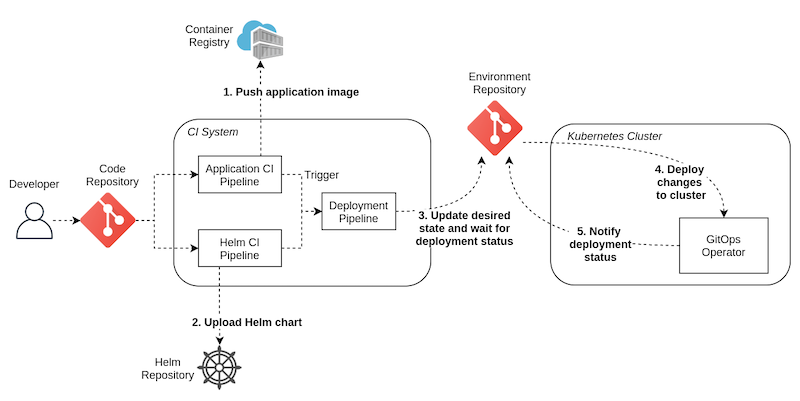
Imagine managing a city where every streetlight, traffic signal, and road sign updates itself automatically whenever a planner approves a change on the blueprint. No confusion, no miscommunication — just a synchronised, self-adjusting system. That’s what GitOps brings to configuration management in the DevOps world.
Instead of manually updating infrastructure, GitOps uses Git repositories and pull requests as the single source of truth. This transforms infrastructure management into something predictable, auditable, and efficient — much like version-controlling code, but for your operational world.
The Blueprint Analogy: Git as the Master Plan
In GitOps, the repository is not just storage — it’s the master blueprint for your entire digital city. Everything, from servers to networking configurations, exists as code. This version-controlled environment means that every change is recorded, reviewed, and reversible.
When developers submit a pull request, they’re essentially proposing a new road or bridge in the city. Once approved, automation tools implement those changes, ensuring consistency between the blueprint (Git) and the real-world city (your live infrastructure).
By mastering these principles through a DevOps training centre in Bangalore, professionals learn how Git becomes the backbone of reliable, traceable configuration management systems used by top tech organisations.
Automation: The Heartbeat of GitOps
Automation in GitOps is like a team of skilled engineers who never sleep. Once a change is committed to the Git repository, automation tools like ArgoCD or Flux take over — deploying updates, verifying consistency, and rolling back if something goes wrong.
This continuous reconciliation ensures that the live environment always matches what’s defined in Git. If a configuration drifts due to an unintended manual change, the system automatically corrects it. The outcome is a near self-healing infrastructure that thrives on clarity and control.
This shift removes the need for manual updates, reducing human error and accelerating delivery — key goals in any DevOps environment.
Pull Requests: Conversations, Not Commands
Every pull request in GitOps is more than a line of code — it’s a conversation. Teams discuss why a change is needed, what it impacts, and how it fits into the bigger picture. These collaborative reviews bring transparency and accountability to infrastructure updates.
Just as a city council reviews blueprints before construction, DevOps teams assess pull requests before merging them into production. This ensures that every deployment aligns with business goals, compliance standards, and technical policies.
For engineers, understanding this communication-first model of infrastructure management is crucial. A DevOps training centre in Bangalore often emphasises these collaborative workflows, helping learners build both technical and teamwork skills essential for large-scale environments.
Security and Auditing: Trust Built into Every Commit
In traditional operations, changes are often undocumented, leaving room for mistakes or breaches. GitOps eliminates this risk by embedding trust and traceability into every step. Since all modifications go through Git, you have a complete history of who changed what and when.
This audit trail makes compliance checks effortless. Security teams can easily track infrastructure evolution, assess vulnerabilities, and roll back unsafe configurations. In industries where regulations demand proof of control, GitOps provides verifiable assurance.
Additionally, by limiting who can approve and merge changes, GitOps aligns with the principle of least privilege — a cornerstone of modern cybersecurity.
Why GitOps Scales with Your Organisation
As teams grow, maintaining consistency across multiple environments becomes increasingly complex. GitOps scales naturally because it relies on standardised workflows. Developers, operations engineers, and security teams can all collaborate through a single Git-based process.
It’s not about adding more tools — it’s about using the same familiar Git interface to handle both code and configuration. This unified approach improves productivity and fosters cross-functional harmony.
Large enterprises use GitOps to orchestrate thousands of deployments daily, ensuring that innovation doesn’t compromise stability.
Conclusion
GitOps turns configuration management into a disciplined, automated, and collaborative process — one where Git becomes the single source of truth, and automation ensures fidelity between code and reality.
For organisations, it’s not just about efficiency; it’s about building systems that are resilient, transparent, and adaptable. For professionals, mastering GitOps represents a new level of DevOps maturity — one that transforms chaos into control and speed into stability.
Just as a well-planned city thrives on a consistent blueprint, modern infrastructure flourishes under GitOps — where every change, big or small, starts with a commit and ends with confidence.